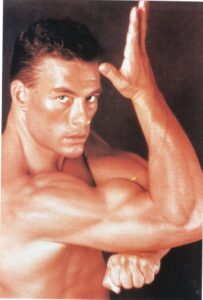
Before his name became synonymous with explosive action, precision combat, and unforgettable cinematic presence, Jean-Claude Van Damme lived a childhood defined not by strength, but by silence. He was not the loudest voice in the room, nor the strongest presence on the playground. Instead, he existed on the edges—observing, absorbing, and quietly shaping a world within himself. While others competed for attention, he found comfort in stillness, discovering early on that true power does not always announce itself. It often grows unnoticed, hidden beneath layers of doubt, discipline, and quiet resilience.
Born into a modest Belgian household, his early life was marked by contrast. His father valued toughness and discipline, while his mother carried a softer, more distant presence. Between these two forces, the young boy struggled to find his place. He was small, sensitive, and often misunderstood. Classmates saw him as different, even fragile. Yet what they mistook for weakness was something far more complex—a deep awareness of movement, rhythm, and expression. He didn’t just see the world; he studied it. Every motion, every gesture, every interaction became part of an unspoken education that would later define his entire career.
At the age of ten, his life took a decisive turn when he stepped into a ballet studio for the first time. What others might have dismissed, he embraced fully. In that quiet room lined with mirrors, he found something he had never known before: control. Ballet gave structure to his thoughts, purpose to his movements, and meaning to his silence. Each position, each step, each breath required discipline and focus. It was not simply dance—it was mastery over the body. While the world outside mocked softness, inside the studio he discovered that grace demanded strength, and precision required endurance. Without realizing it, he was building the foundation of something extraordinary.
But life, as it often does, introduced conflict. Outside the studio, he was still vulnerable. One moment—being pushed, mocked, unable to defend himself—ignited a realization that would change everything. Grace alone was not enough. He needed strength, not just within, but outwardly. That realization led him to a karate dojo, where a new chapter began. At first, the transition was difficult. His movements were elegant but lacked force. He was fluid, but not yet powerful. Yet slowly, something remarkable happened. The dancer and the fighter began to merge.
Where others relied on brute strength, he relied on timing, balance, and flow. His kicks were not just strikes—they were extensions of choreography. His movements carried rhythm, precision, and control. His instructors noticed immediately. He didn’t fight like the others. He moved differently. He flowed. Ballet had not made him weaker—it had made him unique. It gave him an advantage that could not be taught in a typical training environment. It gave him identity.
As his skills developed, opportunities began to appear. Small roles, background performances, and stunt work slowly introduced him to the world of film. What set him apart was not just his ability to fight, but the way he made movement look effortless, almost artistic. Directors saw something rare—a performer who could turn combat into visual storytelling. Every punch had rhythm. Every kick had intention. Every scene felt composed rather than chaotic. It wasn’t violence—it was expression.
His breakthrough came when audiences first witnessed that signature blend of grace and power on screen. Films like Bloodsport introduced the world to a new kind of action star—one who didn’t just dominate physically, but captivated visually. His flexibility, speed, and control became iconic. The splits, the spinning kicks, the controlled intensity—these weren’t just techniques. They were the result of years spent in silent rooms, repeating movements until they became instinct. What audiences saw as talent was, in reality, discipline refined over time.
As his fame grew, so did his legacy. He became a symbol of strength, yet behind that image was a story few fully understood. He was not built by aggression alone, but by duality. Ballet and martial arts. Softness and strength. Stillness and action. He embodied a philosophy rarely seen in the world of action cinema—that true mastery comes not from rejecting who you are, but from embracing every part of it. His past was not something to overcome. It was something to transform.
Even in later years, as the demands of fame and physical strain took their toll, his approach to movement remained unchanged. He continued to view motion as a form of expression—a language without words. Whether performing on screen or training in silence, he carried the same mindset that began in that ballet studio: control, awareness, and intention. He once reflected that fighting and dancing are not opposites, but reflections of the same principle—one creates, the other confronts, but both require discipline, rhythm, and heart.
Today, his journey stands as more than just a story of fame. It is a reminder that strength is not always loud, and power is not always aggressive. Sometimes, it is built quietly, through repetition, through discipline, through moments of doubt that no one else sees. The boy who once stood unnoticed in the corner became a man who commanded global attention—not by changing who he was, but by mastering it.
And perhaps that is the most powerful lesson of all: greatness does not come from fitting into expectations. It comes from redefining them.