A dramatic moment on Wheel of Fortune has sparked intense viewer debate after contestant Jenn Walker appeared to solve a puzzle correctly, only to be denied the prize because of a technical rule violation that many fans at home either missed completely or felt should not have mattered under the circumstances.
The incident unfolded during a December 5 broadcast and quickly spread across social media, where fans began arguing over whether the show handled the situation fairly or whether Walker was unfairly penalized despite clearly knowing the correct answer.
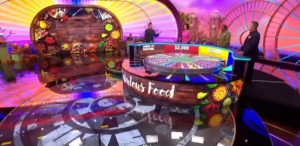
The controversy also placed renewed attention on Ryan Seacrest, who recently stepped into one of television’s most difficult hosting roles following Pat Sajak’s retirement. Although Seacrest’s transition has generally drawn strong viewership and steady interest, this particular moment became one of the most debated scenes of his early time as host.
For many viewers, the entire controversy came down to one small but crucial detail:
Jenn Walker gave the correct answer, but she apparently did not press her buzzer first.
The drama occurred during the show’s fast-paced Triple Toss-Up round, a portion of the game where speed, timing, and accuracy all matter at once. In these puzzles, contestants must buzz in before giving their answer. The format creates pressure because players have only a short window to respond before the board fills in further or another contestant gets a chance.
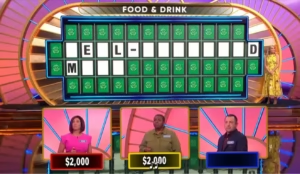
The category was Food and Drink.
As letters appeared on the board, contestants quickly tried to solve the phrase. One competitor, Clint, guessed incorrectly with “Well-Seasoned Meal.” Another contestant, Adrianne, began responding with “Well…” but failed to complete the phrase.
That left Jenn as the only remaining contestant eligible to answer.
At that point, viewers expected the moment to end simply. The answer seemed within reach, and Jenn appeared ready to solve it.
Seacrest turned toward her and encouraged her calmly.
“It’s down to you, Jenn, so take your time and don’t let it fill out,” he told her.
Jenn then confidently answered:
“Well-Balanced Meal.”
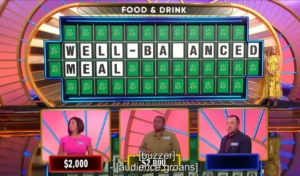
The answer was correct.
For a brief second, it seemed like she had won the $2,000 Triple Toss-Up prize. Many viewers expected applause, music, and a quick move to the next moment.
Instead, Seacrest suddenly announced:
“Buzzer!”
The mood changed immediately.
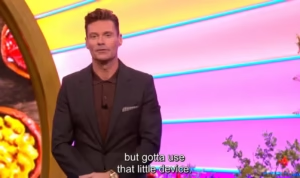
Confusion spread across the stage as contestants and audience members appeared to process what had happened. Jenn had solved the puzzle verbally, but according to the ruling, she had not officially buzzed in before giving the answer.
That technical detail changed everything.
Under the rules, contestants must signal before answering, even if they are the only person left who can respond. Because Jenn spoke before pressing her buzzer, the answer was ruled invalid despite being correct.
Seacrest appeared unsure himself as he looked toward producers and judges off-camera for clarification.
“She didn’t buzz but gave an answer?” he reportedly asked while waiting for the final decision.
After a brief delay, the ruling stood.
Jenn would not receive the $2,000.
The reaction online was immediate.
Many viewers were furious. They argued that the rule felt unnecessarily harsh because Jenn was already the only eligible contestant left. Since no one else could answer, some fans believed the buzzer requirement served no real purpose in that specific moment.
“She literally solved it correctly,” one frustrated viewer wrote.
Another fan asked, “If she’s the only one left, why does the buzzer even matter?”
Others pointed to the pressure of the moment. Game shows move quickly, and contestants are standing under bright lights, in front of cameras, with a studio audience watching every move. Supporters argued that forgetting to press a button during such a tense moment was understandable and should not have erased an obviously correct response.
Some viewers also criticized the production team, saying the rules should have been explained more clearly in the moment. Others questioned whether Seacrest could have helped guide the situation more smoothly before the ruling became final.
However, not everyone agreed.
A significant number of fans defended the show’s decision, arguing that rules must be enforced consistently, especially when prize money is involved. To them, buzzing in is not a minor detail — it is part of the structure of the round.
“If they ignore the rule once, where do they stop?” one viewer argued.
Another wrote, “The buzzer is part of the game. You have to buzz before answering. That’s always been the rule.”
The debate quickly split fans into two camps.
One side viewed the decision as overly technical and unfair.
The other side viewed it as a necessary enforcement of standard game rules.
What made the controversy even more interesting was that the rejected answer did not ultimately change the final outcome of the episode. Clint still finished as the overall champion with $26,150, while Jenn ended the night in second place with $20,490.
Even so, the moment felt emotionally significant because Jenn clearly knew the answer. Viewers watched her solve the puzzle correctly, then lose the prize over a procedural detail.
That sudden reversal created sympathy.
Many fans focused less on the money and more on the emotional weight of the situation. Jenn’s visible disappointment made the moment difficult to watch, especially because the answer itself was never in question.
The controversy also reopened a broader conversation about how strictly game shows should enforce technical rules. Shows like Wheel of Fortune rely on consistency to avoid accusations of favoritism. If producers bend the rules in one contestant’s favor, even for understandable reasons, it could create problems later.
At the same time, viewers often judge fairness emotionally. When someone clearly knows the correct answer, many people naturally feel they should be rewarded, even if a technical mistake occurred.
That tension is exactly why the moment became so widely discussed.
It was not just about a puzzle.
It was about what fairness should mean under pressure.
The rise of social media has made these controversies much larger than they once would have been. Years ago, a disputed game show moment might have been discussed briefly among viewers and then forgotten. Today, clips circulate instantly across TikTok, X, Facebook, Reddit, and YouTube, where fans can replay, slow down, analyze, and argue over every second.
Jenn Walker’s buzzer mistake had all the ingredients of a viral game show controversy:
A correct answer.
A technical rejection.
A visibly disappointed contestant.
An awkward pause.
A new host under scrutiny.
And a rule that many casual viewers did not fully understand.
That combination made the moment explode online.
The incident also added to the ongoing discussion around Ryan Seacrest’s role as host. Replacing Pat Sajak was always going to be a major challenge. Sajak spent decades becoming one of the most familiar faces in American television, and longtime viewers naturally compare Seacrest’s every move to the show’s previous era.
Some critics felt Seacrest looked uncertain during the exchange and should have advocated more clearly for Jenn. Others defended him, noting that hosts do not make official rulings in disputed situations. Those decisions come from judges and producers behind the scenes.
In reality, Seacrest appeared to be navigating the confusion in real time, just like many viewers at home.
That visible uncertainty may have made the moment even more memorable. It did not feel polished or routine. It felt live, awkward, and genuinely tense.
This was not the first time Seacrest’s early tenure sparked debate over rule communication. Some viewers previously criticized another episode in which a contestant lost possession of a valuable $1 million wedge after confusion over the rules. That earlier controversy resurfaced after Jenn’s rejected answer, with some fans arguing that the show should make high-pressure rules clearer for contestants.
Others dismissed that criticism, saying Wheel of Fortune has always required contestants to understand and follow the rules carefully.
Still, even many viewers who agreed with the ruling admitted the moment was painful.
Jenn solved the puzzle.
She said the correct phrase.
For several seconds, it seemed like she had won.
Then the prize disappeared because of one missed button press.
That emotional reversal is exactly why the clip resonated so strongly.
People are naturally drawn to moments where success appears certain, then vanishes because of a tiny detail. It creates frustration, sympathy, and endless debate over what should have happened.
In many ways, the controversy demonstrates why Wheel of Fortune remains compelling after so many decades on television. Viewers are not only watching letters appear on a board. They are watching ordinary people experience pressure, joy, disappointment, embarrassment, and split-second decisions in front of millions.
Jenn Walker’s moment captured all of that at once.
It lasted only seconds, but it gave fans days of discussion.
And judging by the reactions still appearing online, viewers remain divided over one central question:
Should knowing the correct answer have been enough?
Or are the rules still the rules — even when everyone knows the contestant solved the puzzle?