The first thing Eleanor noticed about the house was the color.
Not bright pink.
Not cheerful pink.
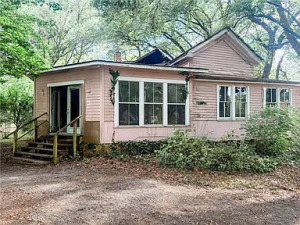
But the faded, weather-worn pink of something that had once been deeply loved and then slowly forgotten.
The old Victorian stood quietly at the end of a shaded street in Citronelle, its wraparound porch sagging slightly beneath years of Southern rain, summer heat, and passing seasons. White trim curled delicately around the tall windows. The roofline rose in steep angles against the cloudy afternoon sky. Even from the curb, the house carried a strange kind of presence — part elegance, part loneliness.
“It looks like it remembers things,” her daughter Lucy whispered from the back seat.
Eleanor almost smiled.
Because somehow, the child was right.
The listing had seemed ordinary enough.
Three bedrooms. Two bathrooms. Original hardwood floors. High ceilings. As-is condition.
But something about the photographs online had unsettled Eleanor in a way she could not explain. Every room seemed frozen between abandonment and waiting, as though the house expected someone to return.
After her husband Daniel died eighteen months earlier, Eleanor had stopped believing places could hold emotions. Grief had flattened the world into practical decisions.
Pay bills.
Keep moving.
Take care of Lucy.
Sleep when possible.
Repeat.
But standing across from the faded pink Victorian that gray afternoon, she felt something unfamiliar stirring beneath her exhaustion.
Curiosity.
The realtor, a cheerful woman named Patricia, unlocked the gate while speaking enthusiastically about “historic charm” and “excellent restoration potential.” Eleanor barely listened. Her attention remained fixed on the porch swing moving slightly in the breeze, even though nobody sat there.
The wood creaked softly.
Almost like a sigh.
Inside, the house smelled faintly of cedar, dust, and old paper.
Lucy wandered immediately toward the staircase, her sneakers echoing across hardwood floors worn smooth by generations of footsteps. The ceilings were impossibly high. Sunlight streamed through tall windows, illuminating particles of dust like tiny stars suspended in the air.
Every room felt alive with traces of people no longer there.
In the dining room, Eleanor paused beside a long window overlooking the backyard.
“I can picture Christmas dinners here,” she murmured.
Patricia smiled. “That’s exactly what most people say.”
The kitchen needed work. The wallpaper peeled slightly near the corners. Several cabinets leaned unevenly. The countertops were worn, and the old fixtures had clearly seen better days. But none of the imperfections bothered Eleanor the way modern houses often did.
New homes felt temporary somehow — built quickly, polished carefully, designed to impress strangers.
This house felt rooted.
Honest.
Like it had survived things.
Then Lucy called from upstairs.
“Mom! You need to see this!”
Eleanor climbed slowly, one hand sliding along the polished banister. At the end of the hallway, Lucy stood inside a small bedroom painted pale yellow.
“There’s writing on the wall,” she said quietly.
Near the closet door, faded pencil marks climbed vertically across the wallpaper.
Names.
Dates.
Measurements.
Children’s heights carefully recorded year after year.
Someone had raised an entire family inside this room.
Eleanor touched the markings gently.
For a brief moment, she imagined mothers standing exactly where she stood now, watching children grow taller against these same walls decade after decade.
The realization struck harder than she expected.
Because after Daniel’s death, Eleanor had stopped imagining a future anywhere. Every plan ended at survival. Nothing beyond that felt real anymore.
Yet this house whispered something dangerous.
Maybe life could continue here.
Maybe memories did not only belong to the past.
In the attic, they discovered old trunks covered in dust.
Patricia apologized immediately. “The previous owners left a few things behind.”
But Lucy had already knelt beside one.
Inside were photographs.
Dozens of them.
Black-and-white family portraits. Birthday parties. Christmas mornings. Children posing beside bicycles. A wedding photograph from the 1940s.
And beneath everything, a handwritten letter folded carefully inside yellowed paper.
Eleanor hesitated before opening it.
The ink had faded, but the words were still legible.
To whoever lives here next,
Lucy moved closer as Eleanor continued reading.
We loved this home with our whole lives. Every floorboard carries laughter. Every window has witnessed heartbreak and healing. If these walls sometimes feel heavy, it is only because they remember us.
Eleanor stopped reading for a moment.
The attic became very quiet.
The letter continued.
My husband built the back deck himself after returning from the war. My daughter learned piano in the front room. My son carved his initials beneath the porch railing when he was ten years old and thought nobody noticed. We buried our first dog beneath the oak tree in the yard. We argued here. We celebrated here. We grieved here too.
Lucy’s eyes widened.
“It’s like the house is alive,” she whispered.
Eleanor folded the letter carefully.
“No,” she said softly. “It was loved.”
But privately, she was not entirely sure.
After Daniel died from a sudden heart attack, Eleanor had spent more than a year trying not to feel attached to anything. Attachment felt dangerous. Losing people hurt too much.
The small rental apartment she and Lucy moved into afterward reflected that emotional survival perfectly.
Temporary furniture.
Blank walls.
Nothing personal.
Nothing rooted.
Nothing capable of breaking her heart again.
Yet this old pink house, with its creaking floors and fading wallpaper, made her feel something she had not allowed herself to feel since Daniel’s funeral.
Home.
Not the practical version involving addresses, contracts, and mortgages.
The deeper version.
The emotional version.
The kind built slowly through ordinary moments repeated over years.
Dinner conversations.
Holiday mornings.
Children running down hallways.
Quiet evenings on porches.
Shared grief.
Shared joy.
Shared life.
Back downstairs, Patricia explained that the property had sat empty for nearly three years after the elderly owner passed away.
“The family couldn’t agree what to do with it,” she said. “Some wanted to sell immediately. Others couldn’t bear the thought.”
Eleanor understood that completely.
After loss, even objects become emotional territory.
Daniel’s old coffee mug still sat untouched in her kitchen cabinet because throwing it away somehow felt like betrayal. Grief makes ordinary things impossibly complicated.
Before leaving, Eleanor stepped onto the back deck alone.
Rain clouds gathered above the trees while wind rustled through the overgrown bushes. The yard was not perfect. Neither was the house. Both carried visible wear.
But strangely, that imperfection comforted her.
Because grief had changed her too.
And maybe broken things recognized one another.
Lucy appeared beside her quietly.
“Can we buy it?” she asked.
Eleanor looked down at her daughter carefully.
Children often adapt faster than adults after tragedy. Lucy missed her father terribly, but unlike Eleanor, she still believed life could become beautiful again.
“I don’t know,” Eleanor answered honestly.
But that night, long after they returned to the rental, she could not stop thinking about the Victorian.
Not the square footage.
Not the renovation costs.
Not the investment value.
The feeling.
That strange, impossible feeling that the house had been waiting.
A week later, Eleanor returned alone.
Patricia had given permission for another walkthrough. Inside, afternoon sunlight spilled across the hardwood floors in warm golden strips. Without conversation filling the rooms, the house felt even quieter than before.
Yet not empty.
Never empty.
In the living room, Eleanor noticed something she had missed during the first visit: a faint outline on the wallpaper where framed photographs once hung. Rectangles slightly less faded than the surrounding walls.
Proof of years spent displaying family memories.
Suddenly, she imagined her own photographs there.
Daniel holding Lucy at the beach.
Christmas mornings.
Birthdays.
Normal life.
The thought startled her so deeply she had to sit down.
Because for the first time since becoming a widow, Eleanor accidentally pictured a future instead of merely surviving the present.
Tears came before she could stop them.
Not dramatic sobbing.
Just quiet grief finally softening around the edges.
The house did not erase her pain.
It simply made space for it.
And perhaps that was the difference.
Later, while walking through the backyard, Eleanor discovered the carved initials beneath the porch railing exactly where the letter had described.
T.H. — 1958.
The tiny detail affected her more than expected.
Someone remembered.
Someone had loved this place enough to leave pieces of themselves behind.
Standing beneath the oak tree, Eleanor finally understood why the house unsettled her so much.
It was not because it felt haunted.
It was because it felt human.
Modern homes often felt staged for resale — clean, polished, emotionally neutral. But this Victorian carried visible evidence of real living.
Real families.
Real loss.
Real joy.
And after eighteen months of emotional numbness, that honesty felt overwhelming.
A few days later, Eleanor made an offer.
Friends questioned her decision immediately.
“The repairs will cost a fortune.”
“Old houses become money pits.”
“Why not buy something newer?”
But none of them understood what Eleanor herself barely understood.
She was not buying perfection.
She was choosing permanence.
Choosing roots.
Choosing the possibility of beginning again somewhere that understood brokenness.
The sale closed six weeks later.
On the first evening inside their new home, Lucy sat cross-legged on the living room floor eating pizza from paper plates while rain tapped gently against the tall windows.
“It already feels different here,” she said quietly.
Eleanor looked around slowly.
Boxes lined the walls. Dust still clung to corners. The kitchen remained outdated. Nothing was finished.
And yet Lucy was right.
The house felt alive again.
Not because of ghosts or mystery.
But because homes are shaped by the people willing to keep loving them.
That night, after Lucy fell asleep upstairs, Eleanor stepped onto the front porch alone. Warm air drifted through the trees while distant porch lights glowed softly across neighboring homes.
For the first time in nearly two years, the future no longer felt like an empty hallway she was afraid to walk through.
It still felt uncertain.
Tender.
Fragile.
But possible.
She thought again about the letter left in the attic.
Every floorboard carries laughter. Every window has witnessed heartbreak and healing.
The family who wrote those words probably never imagined that a grieving widow and her daughter would one day read them during another painful chapter of life.
Yet somehow, across decades, the house had connected them anyway.
That realization stayed with Eleanor long after the lights inside went dark.
Because maybe homes are never truly just structures.
Maybe they are collections of human moments layered carefully over time.
Love.
Loss.
Birthdays.
Arguments.
Recoveries.
Goodbyes.
Second chances.
And maybe certain houses wait patiently for new people not merely to occupy them, but to continue the story.
As the porch swing creaked softly beside her in the warm Southern night, Eleanor realized something important at last.
The pink Victorian had never simply been for sale.
It had been waiting for someone ready to come home again.