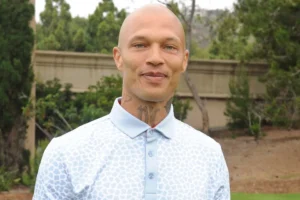
The modern digital era has fundamentally transformed how stories are created, amplified, and remembered, giving extraordinary power to singular moments capable of reshaping an individual’s entire life. Few narratives illustrate this phenomenon more vividly than the journey of Jeremy Meeks, whose life took an unimaginable turn due to one unexpected photograph. In 2014, a routine police booking image—meant to serve as a standard administrative record—was uploaded online. What followed was an unprecedented surge of attention, as millions across the globe became captivated by the image. The contrast was striking: a man associated with criminal charges, yet possessing features that aligned more closely with the world of high fashion. His sharp facial structure, piercing eyes, and composed expression turned what should have been an ordinary record into a viral sensation. Social media platforms became the driving force behind this transformation, rapidly circulating the image and generating discussions that ranged from admiration to ethical concern. Some praised his appearance, while others questioned the morality of celebrating someone entangled in legal issues. Regardless of perspective, the moment underscored the unpredictable power of digital visibility, revealing how quickly public perception can shift and how a single image can redefine identity in a hyperconnected world.
Before this moment of global exposure, Jeremy Meeks’ life was shaped by a far more complex and challenging reality. Raised in Stockton, California, he grew up in an environment marked by economic hardship, instability, and exposure to crime and addiction. These conditions played a significant role in shaping his early experiences, limiting access to opportunities and contributing to a cycle that often led individuals into conflict with the law. By adulthood, Meeks had already accumulated a criminal record, including serious charges that reflected the struggles of his upbringing. His story mirrored that of many individuals caught in similar circumstances, where systemic limitations and environmental pressures create barriers to growth and change. At that time, his physical appearance—later to become a defining factor in his transformation—held little relevance in his daily life. Survival, rather than self-presentation, was the priority. When he was arrested again in 2014 and sentenced to prison, it appeared to be another continuation of an already established trajectory. Yet, unbeknownst to him, the photograph taken during that arrest was spreading across the globe, capturing the attention of people far removed from his reality. This convergence of hardship and unexpected opportunity reveals how life can pivot in ways that defy expectation, turning even the most difficult circumstances into potential turning points.
The period following his release from prison marked a decisive shift in Meeks’ life, defined not by chance alone, but by deliberate choice and discipline. Faced with an opportunity that few could have predicted, he chose to embrace a completely new direction rather than return to familiar patterns. Entering the world of modeling required more than appearance—it demanded professionalism, consistency, and adaptability. Signing with a modeling agency provided him with a structured pathway into an industry where expectations are high and competition is relentless. Early in his career, Meeks demonstrated a capacity to meet these demands, appearing in photoshoots, campaigns, and runway shows that showcased not only his physical appeal but also his ability to connect with the camera. Major fashion brands began to recognize his potential, seeing in him not just a face, but a story that resonated with audiences. Media coverage amplified this narrative, framing his journey as one of redemption and second chances. However, what distinguished Meeks from countless other viral sensations was his ability to convert fleeting attention into sustained success. Viral fame often fades quickly, but through focus and commitment, he transformed it into a long-term career. His transition into acting further expanded his portfolio, allowing him to explore new forms of expression and challenge preconceived notions about his capabilities.
As his career evolved, Meeks demonstrated a growing awareness of the importance of diversification and long-term stability. Rather than relying solely on modeling and media attention, he began to explore opportunities in entrepreneurship, positioning himself as more than just a public figure shaped by circumstance. Launching his own ventures and collaborating with established brands allowed him to take greater control of his narrative and financial future. This transition required a different skill set—strategic thinking, business insight, and an understanding of market dynamics. It also reflected a broader trend in modern celebrity culture, where success is increasingly tied to the ability to adapt and create value beyond initial recognition. Meeks’ journey in this regard highlights the potential for individuals to redefine themselves when given the opportunity and the willingness to pursue it. His rise also sparked important conversations about privilege, appearance, and the influence of media in shaping opportunities. Critics questioned whether his success was primarily a result of his looks rather than his efforts, while supporters viewed his story as proof that transformation is possible. These discussions add complexity to his narrative, reminding us that success is rarely the product of a single factor, but rather the intersection of personal determination and external circumstances.
In 2024, Meeks added another dimension to his story by entering the literary world, offering a more introspective perspective on his life through his autobiography. This step represented a significant shift—from being the subject of public fascination to becoming the author of his own narrative. Through his writing, he explored not only the milestones of his career but also the struggles, mistakes, and lessons that shaped his journey. By addressing these aspects openly, he presented a more nuanced and complete portrayal of his life, emphasizing accountability, growth, and self-awareness. This level of transparency allowed audiences to move beyond the surface-level intrigue that initially defined his public image, gaining insight into the effort required to achieve transformation. His willingness to reflect on his past and articulate the lessons he has learned demonstrates a commitment to personal development that extends beyond professional success. It also highlights the responsibility that comes with visibility, particularly when one’s story has the potential to inspire others. In sharing his experiences, Meeks contributed to a broader conversation about redemption, resilience, and the possibility of change, reinforcing the idea that individuals are not defined solely by their past.
Today, Jeremy Meeks stands as a multifaceted figure whose journey encapsulates both the unpredictability and the potential of the digital age. Balancing roles as a model, actor, entrepreneur, and father, he continues to navigate a path that few could have anticipated when his mugshot first appeared online. His story serves as a powerful reminder of how quickly circumstances can change and how critical it is to recognize and act upon opportunity. At the same time, it underscores the importance of resilience, discipline, and self-belief in sustaining success over time. What began as a moment of controversy has evolved into a broader narrative about reinvention and the capacity for growth. It challenges assumptions about identity and potential, encouraging a more thoughtful understanding of how individuals can evolve beyond their past. Ultimately, his experience reflects a larger truth about contemporary society: that opportunity can arise from the most unexpected places, and that with determination and adaptability, even the most unlikely beginnings can lead to extraordinary outcomes.