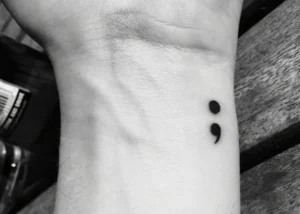
At first glance, it appears almost invisible in meaning—a small mark, simple and unassuming, made up of nothing more than a dot and a curved line. A semicolon. It is easy to overlook, easy to dismiss as a stylistic choice or a minimalist design. Yet for millions of people across the world, this tiny symbol carries a depth of meaning that words alone often fail to express. It is not merely punctuation; it is a declaration. It is a quiet but powerful statement about survival, endurance, and the decision to continue when everything inside a person may have urged them to stop. What makes the semicolon so profound is not its size or appearance, but the story it represents—a story of struggle, pain, and ultimately, choice. In a world where suffering is often hidden behind smiles and silence, this small mark becomes a visible reminder that behind every person, there may be a chapter that nearly ended but didn’t.
The meaning of the semicolon is rooted in grammar, where it serves a specific purpose. A semicolon is used when a sentence could logically come to an end, but the writer chooses to continue instead. It is a pause, not a conclusion. This simple rule of language has been transformed into a powerful metaphor for life itself. For those who wear it as a tattoo, the semicolon represents a moment when their own story could have ended—but didn’t. It symbolizes the choice to keep going, even when continuing felt impossible. It does not deny the existence of pain, nor does it pretend that everything is resolved. Instead, it acknowledges that there was a breaking point, a moment of darkness, and that despite it, the story continued. This interpretation resonates deeply with individuals who have faced depression, anxiety, trauma, or other mental health challenges. The semicolon becomes a personal declaration: “I am still here. My story is not over.”
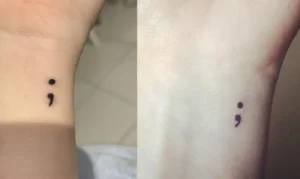
The widespread recognition of this symbol can be traced back to a movement that gave it voice and purpose. In 2013, Project Semicolon was founded with the intention of raising awareness about mental health struggles, including depression, suicide, self-harm, and addiction. The concept was simple yet profoundly impactful: encourage individuals to draw or tattoo a semicolon on their bodies as a sign of solidarity and survival. What began as a small initiative quickly grew into a global movement, connecting people from different backgrounds through a shared understanding of resilience. The semicolon became more than a symbol—it became a language. Without speaking a word, it allowed individuals to communicate experiences that are often difficult to articulate. It created a silent network of support, where one person could recognize another and feel less alone. In this way, the semicolon transcended its grammatical origins and became a universal sign of empathy and connection.
Part of what gives the semicolon its power is its simplicity. Unlike larger, more elaborate symbols, it does not demand attention. It does not announce itself loudly or seek recognition. Instead, it exists quietly, often visible only to those who understand its meaning. This subtlety makes it deeply personal. For some, the tattoo marks a specific moment in time—a day they survived, a decision they made, a turning point in their life. For others, it represents an ongoing journey, a reminder that the struggle has not ended but neither have they. It is not a symbol of perfection or completion; it is a symbol of persistence. It acknowledges that healing is not linear, that setbacks may occur, and that strength often lies not in never falling, but in continuing to rise. In a society that often celebrates visible success while overlooking internal battles, the semicolon quietly honors the courage it takes to keep going.
Beyond its personal significance, the semicolon also plays an important role in shifting how mental health is perceived. For many years, conversations about mental health were surrounded by stigma, misunderstanding, and silence. People often felt unable to share their struggles, fearing judgment or rejection. The semicolon challenges that silence in a subtle but meaningful way. It opens the door to conversation without forcing it. A simple question—“What does that tattoo mean?”—can lead to deeper discussions about experiences that might otherwise remain hidden. In this way, the symbol becomes a bridge between isolation and connection. It reminds people that they are not alone in their struggles, that others have faced similar challenges, and that there is strength in shared understanding. It also encourages those who have not experienced such struggles to approach the topic with empathy and awareness, fostering a more compassionate and informed perspective.

The placement of the semicolon tattoo often carries its own layer of meaning. Many choose to place it on the wrist, a location that is both visible and symbolic. The wrist is an area associated with vulnerability, and for some, it represents a space where pain was once felt most intensely. By placing the semicolon there, individuals reclaim that space, transforming it from a site of struggle into a symbol of survival. Others choose locations that are more private, such as the ankle, collarbone, or behind the ear, keeping the meaning close to themselves. Some incorporate the semicolon into larger designs—combined with butterflies, hearts, or other symbols—adding layers of personal significance. Regardless of where it is placed, the meaning remains deeply rooted in the individual’s story. It is not about visibility or aesthetics; it is about what the symbol represents internally. It is a reminder carried on the body, but lived in the mind and heart.
Ultimately, the semicolon tattoo stands as a powerful reminder that life is not defined by its most difficult moments, but by the choices made in response to them. It does not erase pain or struggle, but it reframes them as part of a continuing narrative rather than an ending. For those who wear it, it is a symbol of agency—the understanding that they are the authors of their own story, even when circumstances feel overwhelming. It is a declaration that while the sentence may have paused, it did not end. In a world where many feel unseen or unheard, the semicolon offers a quiet form of recognition, a way of saying, “I understand,” without needing explanation. It is small, yet immeasurably significant. And perhaps that is its greatest strength: it proves that even the smallest symbols can carry the deepest meaning, reminding us all that no matter how difficult the journey becomes, the story can always continue.