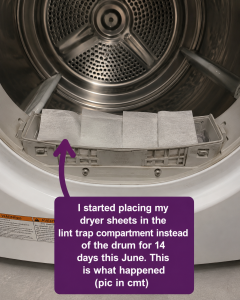
I started this little laundry experiment with a simple question: what would happen if I placed dryer sheets near the lint trap compartment instead of tossing them directly into the dryer drum with the clothes?
At first, it seemed like a harmless and possibly clever idea. Dryer sheets are commonly used to reduce static, add fragrance, and make clothes feel softer. The traditional method is simple: place one sheet inside the dryer drum, let it tumble with the laundry, and allow it to work while the clothes dry. But like many household routines, it is easy to wonder whether there is another way to get similar results with less mess, less residue, or a lighter scent.
So, for fourteen days in June, I tried something different.
Instead of putting the dryer sheet inside the drum, I placed it in the lint trap compartment area before starting the drying cycle. My goal was not to prove that this method was better or safer than the standard approach. I simply wanted to observe what changed, what improved, what became worse, and whether the trick was actually worth repeating.
By the end of the two weeks, the results were more complicated than I expected.
The first thing I noticed was that static cling seemed to decrease. This was especially obvious with synthetic fabrics, athletic clothes, lightweight shirts, and mixed laundry loads that usually come out of the dryer clinging together. Normally, these fabrics can stick to one another, crackle slightly when separated, or attract hair and lint because of static buildup. During the experiment, many of those items came out easier to separate and fold.
That part was genuinely surprising.
Even though the dryer sheet was not tumbling freely among the clothes, it still seemed to have some effect on the drying environment. The laundry did not feel as electrically charged as it sometimes does, and the most static-prone garments were easier to handle right away. For loads where static is the main problem, this was the strongest advantage of the method.
The second noticeable change was the scent.
When dryer sheets are placed directly in the drum, they often leave a stronger fragrance on the clothes. For some people, that fresh laundry smell is the whole point. But for others, especially those who are sensitive to strong scents, it can be too much. During this experiment, the fragrance was lighter and more evenly spread. Instead of opening the dryer door and getting hit with a strong burst of scent, the clothes had a softer, cleaner smell.
The scent was still present, but it was not overwhelming.
This gentler fragrance was one of the more pleasant parts of the test. Shirts, socks, and everyday clothing smelled fresh without feeling heavily perfumed. The smell did not cling as strongly to the fabric, which could be a benefit for anyone who prefers a more subtle laundry scent.
However, the method also had clear drawbacks.
The biggest one was softness. When a dryer sheet tumbles inside the drum, it makes direct contact with the fabrics. That contact helps spread softening agents across the clothes. When the sheet stays near the lint trap area instead, it does not touch the laundry in the same way. Because of that, the clothes did not come out feeling quite as soft as they normally do.
This difference was especially noticeable with towels, blankets, sweatshirts, and heavier cotton items. These fabrics usually benefit most from direct dryer-sheet contact. During the experiment, they still dried normally, and they still smelled lightly fresh, but they did not have the same soft, fluffy finish I expected.
Towels were the clearest example.
They were clean and dry, but they felt slightly rougher than usual. Not uncomfortable, but noticeably less plush. For anyone who uses dryer sheets mainly for softness, this method may feel disappointing. It may reduce static, but it does not deliver the same fabric-softening effect as the traditional drum method.
Another issue was efficiency.
After several loads, I noticed that the dryer sheets themselves looked barely used. When a sheet tumbles inside the dryer, it becomes wrinkled, softened, and clearly spent by the end of the cycle. But when placed in the lint trap compartment area, the sheets often looked almost unchanged. That made me wonder whether the product was actually being used properly or whether part of its effect was being wasted.
This raised an important question: if the dryer sheet is not making direct contact with the clothes, is it really doing enough to justify using it that way?
The answer depends on what result matters most.
For static control, the method seemed to help. For fragrance, it created a lighter effect. But for softness and full product use, it was less convincing. It felt more like a partial benefit than a true replacement for the normal method.
Then there was the most important issue: safety.
Any method that involves placing something near or inside the lint trap area deserves caution. Dryers depend on proper airflow to work safely and efficiently. The lint trap is designed to collect lint while still allowing air to move through the machine. If airflow becomes blocked or restricted, the dryer may take longer to dry clothes, work harder than necessary, or create a potential fire risk over time.
That does not mean one dryer sheet placed nearby will automatically cause a disaster. But it does mean this is not a habit to treat casually. Dryer sheets, lint, heat, and restricted airflow are not things to ignore. The lint trap area should remain clean, open, and able to function the way the dryer manufacturer intended.
This was the part of the experiment that made me rethink the whole hack.
A laundry trick is only useful if it does not create a bigger problem. Saving a little static or getting a lighter scent is not worth interfering with dryer airflow. Even a small restriction can reduce efficiency, and lint-related issues are one of the reasons dryer maintenance matters so much.
Because of that, I would not treat this method as a regular long-term replacement for using dryer sheets properly. It may seem convenient, but it is not the safest or most reliable approach. The traditional method exists for a reason: dryer sheets are meant to tumble with the laundry, not sit in a place that may affect airflow.
Another thing I noticed was that the results varied depending on the type of load.
Small loads seemed to respond better than large ones. With fewer clothes in the dryer, the scent spread more noticeably and static was easier to control. Larger loads were less consistent. Some items came out fine, while others still had mild static or felt less fresh. This made the method feel unreliable for heavy laundry days.
Fabric type also mattered.
Synthetic materials showed the biggest static improvement. Cotton items showed less dramatic change. Towels and blankets showed the biggest softness loss. Delicate items seemed to benefit from the lighter fragrance, but they did not necessarily feel softer. This made it clear that the method was not one-size-fits-all.
The condition of the dryer also matters. A dryer with strong airflow may distribute scent differently than one with a partially clogged vent. A clean lint trap, clear vent, and well-maintained machine will always produce better results than a dryer that is already struggling. This experiment reminded me that laundry hacks often depend on the appliance, the fabric, the load size, and the user’s expectations.
By the end of the fourteen days, I understood why the hack might appeal to people.
It can make laundry smell lightly fresh without the heavier scent that comes from direct dryer-sheet contact. It may reduce static in certain loads. It also keeps the sheet from getting tangled in clothes or disappearing inside fitted sheets, which is a common annoyance.
But I also understood why it should be approached carefully.
The method does not soften fabrics as well. It may not use the dryer sheet efficiently. It may produce uneven results. Most importantly, anything placed near the lint trap area can raise airflow concerns, especially if done repeatedly or carelessly.
For me, the best conclusion was not that this hack is amazing or useless. It is somewhere in between.
It worked in some ways, but not well enough to replace the standard method. For a very small load where the goal is light fragrance and mild static control, it may seem helpful. But for regular laundry, towels, blankets, or loads where softness matters, placing the dryer sheet in the drum still works better.
A safer balanced approach would be to use dryer sheets according to the product and dryer instructions, keep the lint trap clean, and avoid blocking airflow. For people who want less fragrance, using half a dryer sheet in the drum may be a better option. For people who want fewer disposable products, wool dryer balls can help reduce drying time and soften clothes without the same type of chemical coating. For static control, removing clothes before they become overdried can also make a difference.
That may be the most useful lesson from the whole experiment.
Sometimes a household hack sounds clever because it changes a familiar routine. But changing a routine does not always make it better. A trick can offer one benefit while quietly creating another drawback. The only way to judge it fairly is to look at the full result: performance, safety, convenience, cost, and consistency.
After fourteen days, I would describe this lint-trap dryer-sheet method as interesting, but not essential. It reduced static more than I expected and created a lighter scent that I actually liked. But it also reduced softness, made me question whether the sheets were being used efficiently, and raised enough safety concerns that I would not make it my regular laundry routine.
The experiment did teach me something useful, though.
Not every laundry load needs the same solution. Some loads need static control. Some need softness. Some need no fragrance at all. Some are better served by dryer balls, lower heat, shorter drying time, or simply cleaning the lint trap more often.
In the end, placing dryer sheets in the lint trap compartment was not a miracle hack. It was a trade-off. It offered mild benefits, but it also came with limitations that matter.
For everyday use, the traditional method remains the better choice.
For safety, airflow should always come first.
And for anyone tempted to try a viral laundry shortcut, the lesson is simple: if a hack involves the lint trap, think carefully before turning it into a habit. Clean clothes are important, but a safe dryer is even more important.