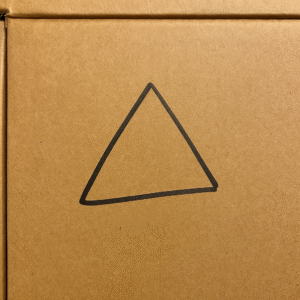
It began with something so small it should have been easy to ignore—a rough, hand-drawn triangle scribbled across the top of a cardboard box. Uneven lines, slightly smudged ink, nothing precise or official. And yet, when my sister saw it, she froze.
To her, it didn’t feel random. It felt intentional.
Within seconds, her mind began filling in possibilities: a hidden code, a warning, a sign left behind for someone else. The more she looked at it, the more meaning it seemed to carry. She called me almost immediately, her voice caught somewhere between confusion and concern: “What does this mean? Is this something bad?”
That single triangle—ordinary, unremarkable—had already become something much bigger. And in that moment, it revealed something important: how quickly the human mind turns uncertainty into a story.
At first glance, it’s easy to understand why something like this stands out. Packages are expected to be clean, labeled, and predictable. Barcodes, printed text, tracking numbers—everything about modern delivery systems feels controlled and precise. So when a simple, handwritten symbol appears, it breaks that expectation. It introduces something unfamiliar into an otherwise structured system.
And when something feels out of place, the mind begins searching for meaning.
But the reality behind these symbols is far less mysterious—and far more human.
Every day, millions of packages move through complex delivery networks. Warehouses process thousands of items per hour, drivers sort and deliver dozens—sometimes hundreds—of parcels on tight schedules. In that environment, speed matters more than perfection. Workers rely on quick visual cues to keep things moving efficiently, and sometimes that means using simple shapes instead of words.
Triangles, circles, check marks, arrows—these are not secret messages. They are shortcuts.
A triangle might mean a package has been grouped with others on a specific route. It might indicate a driver has already verified the address. It could represent a third stop, a sorting batch, or simply a quick reminder to avoid confusion later. Sometimes, it doesn’t even carry a standardized meaning at all—just a personal system a worker uses to stay organized in a fast-paced environment.
What feels symbolic to the recipient is often purely practical to the person who drew it.
And yet, the reaction it creates is real.
Humans are wired to notice patterns, especially unexpected ones. Psychologists refer to this tendency as apophenia—the inclination to see meaning in randomness. When something doesn’t immediately make sense, the brain fills in the gaps, often leaning toward caution or worst-case scenarios.
A triangle is not just a shape. In different contexts, it can symbolize warning, change, or importance. So when it appears without explanation, it carries a weight it was never meant to have.
That’s why moments like this spread so quickly online.
People post photos of marked packages, asking the same question: “What does this mean?” Others respond with theories—some logical, others exaggerated. And within hours, a simple mark becomes a shared mystery, fueled by curiosity and amplified by uncertainty.
But when you step back and look at the reality, the explanation is almost always the simplest one.
Delivery drivers themselves confirm it: marks are tools, not messages. They help avoid mistakes, speed up sorting, and keep track of packages in environments where time is limited and volume is high. There is no system for marking homes, no hidden signals for theft, no coded warnings embedded in scribbles on cardboard.
Just people doing their jobs—quickly, efficiently, and sometimes imperfectly.
When I finally explained this to my sister, the tension in her voice disappeared almost instantly. What had felt like a warning became what it always was: a harmless mark. She laughed, a little embarrassed, a little relieved.
Later that day, she sent me a photo of another delivery.
This time, there was a circle drawn on the box.
We both laughed.
And that’s when it became clear that the real story was never about the triangle itself.
It was about how we interpret the world around us.
In a time where information moves fast and uncertainty feels amplified, even the smallest anomaly can seem significant. A scribble becomes a signal. A shape becomes a question. And a simple moment becomes something worth investigating.
But sometimes, the answer doesn’t require decoding.
Sometimes, it’s exactly what it appears to be.
A mark made in a hurry.
A tool for organization.
A small detail in a much larger system.
The triangle was never a warning.
It was a reminder—of how quickly we search for meaning, how easily we assume complexity, and how often the truth is simpler than we expect.
In the end, it wasn’t the symbol that mattered.
It was the pause. The question. The curiosity.
Because even in something as ordinary as a cardboard box, we’re always looking for a story.
And sometimes, finding out there isn’t one is the most reassuring answer of all.