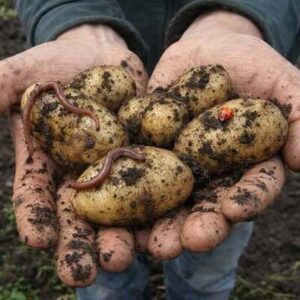
The unusual object captured in the image is a rat-tailed maggot, the larval stage of a hoverfly belonging to the family Syrphidae, most commonly the species Eristalis tenax. At first glance, its appearance can be unsettling—its elongated, pinkish-translucent body and distinctive thread-like “tail” create an impression that feels almost unnatural, especially when discovered indoors. However, what seems mysterious or alarming is actually a highly specialized biological form shaped by evolution. The elongated “tail” is not a tail in the traditional sense, but a breathing tube, allowing the larva to access oxygen while living in environments where air is scarce. The darker end of the body houses its feeding structures, which are used to filter microscopic organic material from its surroundings. The small brown pellets nearby are not eggs or signs of infestation, but rather waste or debris from the environment it came from, reinforcing that the setting in which it was found is not its natural habitat.
Despite its unusual look, this organism plays a valuable role in the natural world. Rat-tailed maggots typically inhabit water rich in decaying organic material, such as stagnant pools, compost areas, or clogged drainage systems. These environments, often overlooked or considered undesirable, are essential ecosystems where decomposition occurs and nutrients are recycled. The larva feeds on bacteria and organic particles, helping break down waste and maintain ecological balance. Its ability to survive in low-oxygen conditions is a remarkable adaptation, allowing it to thrive where many other organisms cannot. Over time, it undergoes a complete transformation, eventually emerging as an adult hoverfly—a harmless and beneficial insect that closely resembles a bee or wasp but plays a crucial role as a pollinator. This transformation highlights the complexity of its life cycle, turning something initially perceived as unpleasant into a key contributor to biodiversity.
Encounters with such larvae in domestic environments are usually accidental rather than indicative of a larger issue. They may be carried indoors through water sources, such as drains, gutters, or containers where moisture has accumulated. Once removed from their natural environment, they cannot survive for long, as they depend on damp conditions to function. Their presence indoors often signals the existence of nearby standing water or organic buildup rather than a direct health concern. Unlike parasitic organisms or harmful pests, they do not bite, sting, or transmit disease. This distinction is important, as misidentification can lead to unnecessary worry or inappropriate attempts at removal. In reality, their appearance should be viewed as an environmental clue rather than a threat, encouraging simple measures such as improving drainage and maintaining clean, dry surfaces.
The reaction to discovering such a creature often reveals more about human perception than about the organism itself. When faced with something unfamiliar, especially in a personal space like a home, the mind tends to interpret it as dangerous. Its unusual shape, movement, and context can trigger instinctive discomfort, leading to assumptions that are not grounded in fact. Yet once its identity is understood, the initial fear often gives way to curiosity. Learning about its role, behavior, and life cycle transforms the experience from one of alarm into one of awareness. It becomes an opportunity to recognize how much of the natural world exists quietly alongside us, often unnoticed until it appears in unexpected ways. This shift in perspective is essential for fostering a more balanced relationship with the environment, where understanding replaces fear.
In a broader sense, organisms like the rat-tailed maggot serve as reminders of the complexity and interconnectedness of ecosystems. Even in human-made environments, traces of natural processes continue to exist, adapting to new conditions and maintaining their roles within the larger system. Their presence highlights how boundaries between indoor and outdoor spaces are not always absolute, and how small changes in moisture or waste management can influence what appears in our surroundings. Rather than viewing these encounters as disruptions, they can be understood as glimpses into ecological processes that are usually hidden from view. This awareness encourages more mindful interaction with the environment, recognizing that even the smallest organisms contribute to maintaining balance.
Ultimately, the discovery of this unusual larva is not a cause for alarm, but an invitation to look closer and understand more deeply. What initially appears strange or unsettling often reveals itself to be part of a larger, purposeful system once examined with knowledge and context. By identifying it correctly as the larval stage of Eristalis tenax, the situation shifts from confusion to clarity, from fear to appreciation. It becomes a small but meaningful reminder that nature is present even in the most ordinary places, and that learning to recognize it allows us to respond with understanding rather than instinctive concern.